
How Shared Causes Can Rally A Team With Andrew Lawler
Tom Dardick sits down with Andrew Lawler, who talks about the importance of establishing shared causes when leading a diverse team focused on achieving long-term success. He reflects on his journey from serving in the military to becoming the COO and President at Barry Isett & Associates. Andrew explores the importance of maintaining a strong people strategy aligned with business goals and how to set ambitious goals while maintaining cultural precepts during periods of growth and change. He also presents his strategies in addressing the challenges of cross-training, employee retention, and maintaining genuine human relationships in the age of AI.
---
Listen to the podcast here
How Shared Causes Can Rally A Team With Andrew Lawler
On the Eye of Power, it's my great pleasure to welcome Andrew Lawler to the program. Andrew and I met on a panel discussion. We were joined by two others. Hopefully, we'll have them on the show, too. We had such a great conversation then. I knew that we would have a good conversation because everything Andrew said was what I would consider dialed into what we talk about in the Eye of Power and with The Mentor Machine program. We're very aligned in terms of what we think matters and what makes a difference for people.
I wrote three pages of notes while Andrew was sharing his story and the story at Barry Isett & Associates. He is the President and COO there. He has been there for fifteen months. It's still new for him, but he has his focus on the right things. You would be as pleased as I am with the amount of knowledge and the amount of focus that he brings to the table on the human equation. Yes, there are the nuts and bolts of doing business, but he strikes me as a leader who is focused on the people side. That's the kind of leader that we all need. Help me welcome Andrew Lawler to the show.
Andrew, you and I met under pretty fun circumstances. We had a successful panel discussion together. I saw you. You were eating up the other people's stuff and saying, “I'm going to use that.” We listened to each other. Everybody weighed in from their perspective. It turned out to be a conversation that almost everybody in the room didn't want to end.
You and I didn't even know each other before. I didn't know anybody on the panel before that, too, but I thought we were able to play off of each other well. You're right. I was eating up what everybody else was saying. I was wishing I was sitting in the audience with my notepad in hand and taking a couple of notes here or there, or hoping that somebody had a video recorder going for it, but nobody did.
I was hoping that it would be videotaped. I don't think it was. All that goodness is in the memories of the people in the room. That's where it is.
There was a lot of energy that came out of that room. Anytime I get into conversations that are specifically about leadership, it brings so many thoughts into my head. It is this constant stream of “This and that. I learned this once upon a time. This lesson probably applies there.” It was a lot of fun to be a part of that.
We'll continue the party now. What we're focused on at the Eye of Power is the ways that all of us humans both increase our personal power, our agency, or squander it. As a leader and an accomplished person, you have obviously been able to marshal at least some percentage of your agency to make things happen. You probably have some things to share with us.
That's debatable.
Leading A Diverse Team At Barry Isett & Associates
As you're now COO and President of Barry Isett & Associates, which is a pretty diversified consulting and engineering-oriented firm, maybe we can start there as to what the organization does and what success looks like over the short and long term for you as a collective mission.
Perhaps we can get into a little bit of the background about how I got here.
I do want to go there, but I want to orient it at first to the present moment. I know you were in the military, and I know you've got a lot of stories.
Barry Isett & Associates is a multidisciplinary engineering and consulting firm with twelve offices across the Eastern half of the state of Pennsylvania. My quick elevator pitch to folks who don't know anything about us is everything for the built environment that you can think of, possibly needing from an engineer or a consultant, but not architecture. That's what we do. We organize ourselves in a matrix. We have three divisions across four different regions that we segment our business into.
Those three divisions are further broken down into eleven different revenue-generating departments, eleven different specialties in the engineering or consulting spaces. Plus, we have two non-revenue-generating departments, so thirteen total departments. The non-revenue-generating departments sit like an umbrella over top of everything else that we do. That's project management or construction services. We use that a lot for multidiscipline.
When a client needs a little bit of this and a little bit of that, we'll wrap it all up underneath a project manager. We have a PMCS team, as we call them. We have a grant writing team as well that can be applied to any segment for any of our customer base. We have a three-person grants team that specializes in finding some money and then helping customers apply that to accomplish their projects. To give you a little bit more detail about some of those departments that we do, those three divisions that I mentioned a moment ago, we have traditional engineering, as people think of engineers most of the time, I feel like.
We call that our Design Division. Included in the Design Division are civil land development, mechanical, electrical, plumbing, and fire protection, MEP engineering, and structural engineering. Those three departments make up our Design Division. We have this middle space. We call it our Field Division. These folks look more like contractors most days of the week. They're wearing high-vis shirts, hard hats, and boots. They're playing out in the dirt in a lot of places. This is our survey team, geotechnical engineering, figuring out what's underneath the earth that people are going to build some form of a structure on.
We have environmental consulting services that we provide with forensic engineering when things go wrong out there in the built environment. We have a group that we call construction quality assurance. These are folks who go out and test any construction materials, whether that be concrete, soil, or steel. They can do indoor air quality types of things as well, like testing, adjusting, balancing, commissioning, and those types of things. All of that is wrapped up in our Field Division.
We have a Public Division, which specializes in code services. That's our biggest department. These are folks who every day of the week are reviewing plans for safety and municipal requirements, code-required items that are out there. They're doing the inspections on commercial, residential, and industrial properties all across the state. We have a municipal engineering group, which services municipalities across pretty much the Eastern half of the state. We have a landscape architecture team as well. We have a vast array of multidiscipline services that we can help various clients with, but we're not architects.
Everything but architecture. Also, if I understand correctly, it's an ESOP company. Correct?
We are an ESOP. Barry Isett, our founder, started the firm with three disciplines in 1977. We started with civil land development, survey, and structural engineering. Those three disciplines have now grown into what I described previously. In 1998, as part of his own transition plan, Barry wanted to make sure that the company would last fundamentally forever. That's ultimately what we're aiming for right now. As a leadership team and as an entire organization, we are built for the long haul.
We are built for what we describe as the marathon pace, the slow, steady, disciplined march when it comes to growth. We don't want to necessarily grow too fast. We don't want to outstrip our resources. We want to fundamentally build a company that lasts forever. That started back in 1998 when Barry decided to start transitioning a lot of the company over to the employees themselves. We went from 30% ESOP when he first founded the ESOP. We're now 42% ESOP. Fifty-eight percent of our company is owned by other shareholders, but they're all employees of the company as well. It's an interesting mix that we have there.
Do not aim to grow your company so fast that you outstrip yourself of resources. Embrace a slow, steady, and disciplined march to build a team that could last forever.
We have about 90 shareholders outside of the ESOP that are independent shareholders. They're all employees of Barry Isett & Associates. The largest shareholder that we have owns 10% of the company. We have two shareholders who each own 10%. Barry himself still owns 5% of the company. A whole lot of people own smaller percentages of it. Forty-two percent of the company is owned by the roughly 300 employees that we have here as part of our ESOP program. It's an interesting arrangement that we have.
Managing The Company's Unique ESOP Structure
It's very interesting and not the usual mix of things. My first question that comes to mind, Andrew, is how does that ownership structure impact things from your position as COO and President? How would it be different if it weren't structured that way? You could do a cost-benefit, or however you want to tackle that. What's your view from that unique position that you're in?
Lots of different thoughts there. I'll start with how it would be different if we were not an ESOP. One of the challenges that all companies have always faced, and in particular, engineering and consulting service companies today, is attracting and retaining talent. That's the number one issue. When we talked at the executive level here, and then when we talked to our department heads and our operations managers, we're always talking about people first. I have this mantra in my head about people, systems, and processes, but everything that we're doing is driven by the people that we have.
If we were not an ESOP, we would see the industry that we're in heading in two directions. We would see a lot of private companies either being bought up by private equity or going down the path of becoming an ESOP as an exit strategy for the current ownership that's there. If we were not an ESOP, we would lose a lot of that motivation on the part of our employee base. What we have here is hard to describe to people unless you've had the ability to come visit with us, talk to our team, walk the hallways, and feel. Everybody talks about culture. We have a special culture.
I've only been here, Tom, for fifteen months. I can say without a doubt that there's something special about us. I pin a lot of that on the fact that we're employee-owned. We reinforce that message. We put our money where our mouth is. When it comes to bonuses or growing the ESOP, we are putting benefit packages together that are employee-first. Being in that environment and in the position that I'm in as Chief Operating Officer and President now, Kevin Campbell, our CEO, and I spend a lot of time trying to figure out what five years from now, ten years from now, and twenty years from now look like.
Almost everything we're talking about is centered around the ESOP itself and trying to make that even more meaningful and more impactful, and trying to outwardly demonstrate. A lot of times, when you get into these types of retirement savings vehicles, it's gray. It's nebulous at best for the employee who's coming to work. They're putting in their time. They're getting their paycheck. They're producing some deliverables. Hopefully, they get a bonus at the end of the year. Hopefully, they get a raise systematically.
They get some promotions along the way, but like, “There's this retirement thing sitting in the background. I don't know what that's worth.” We're trying to make it real. We host a series of webinar discussions and town hall-style meetings for all of our team. It's hard to do across twelve offices, but we're using technology and those types of things. It's all centered around the value of the ESOP and why this matters so much.
Turning me into we is essentially the mindset.
There's no doubt about it. We are all in this together. Those are some lessons, hopefully, most people have learned from an early stage. It is that you're only as good as your weakest link type of mentality.
The founder of Applied Formal Axiology is a guy by the name of Robert Hartman. I don't know if that rings a bell, the Hartman Value Index, ACI.
No. The space you're in, I need to do more research on, Tom. I need to dig in.
We could talk some more. No doubt about that. He was working in the 1950s or the 1960s to develop his psychometric tools, but he died fairly young in 1973. The Hartman Institute continues to this day. He believed that the ESOP, or employee ownership, was the evolution of the corporate structure. That was the highest form. Axiology is the science of value. He's saying empirically that it's the highest form. That's an interesting perspective. He puts the empirical case for these kinds of claims. We can get into the weeds on that for sure.
Lessons And Insights From Andrew’s Military Service
I know we can on that, but I want to turn it back to the more personal story on you because you're fifteen months into this, which means you're still probably observing dynamics, seeing the deeper structures of things, and asking more questions than what you feel like you might have answers to. Let's talk about the journey that got you to this place. From there, where are you now? What makes you excited about the days to come? Get into your arc through that, Andrew, if you don't mind.
I'll try to keep it as brief as I can.
We have some time if you do so.
I tell people that my own personal journey on the professional side, let's say post-graduation from college, has been one of shrinking geography until now. I'm on my way back up again, being here at Barry Isett & Associates. I graduated from the Naval Academy with a degree in Systems Engineering. I got a chance to live out a little boyhood dream of mine. I went out and flew airplanes in the Marine Corps for close to eight years after graduation.
I want to pause right there because you throw it out there like it's this matter-of-fact thing. It is very difficult to get into the Naval Academy and to fly planes in that way. These are high bars. Those are extremely high accomplishments. You're patching through like it's a grace note, but if that was your career, that would be quite a high achievement.
I was reflecting upon what we might be talking about. Every now and again, I catch myself reflecting upon these things anyway, using your agency and how you take life's experiences, for lack of a better term, and make something out of them or give up because of them in the various stages. To me, Tom, and I mean this sincerely, I appreciate you saying that about the high bar, the Naval Academy, and the Marine Corps. To me, it has never been about me, but it has always been about doing the best possible job that I could do to help other people along the way with the talents, the gifts, and the blessings that I've been bestowed by God and formed by others.
That's truly the way I've tried to live my life. It's not about me, but if I've been blessed with any talents, I had better be damn sure that I use them for the best possible outcomes. I grew up in the Top Gun generation. That would be awesome to be able to fly airplanes in the military. As a little kid, one of my basketball coaches was like, “You've got a lot of discipline.” I put that on my family and the environment that I was raised in. “You've got a lot of discipline. You should check out one of the service academies.” “I'll check it out.”
My father was Army ROTC. He served for a three-year tour at the tail end of Vietnam type of a thing. My grandfather was in the Navy. I never knew any stories about that growing up. I didn't have a lot of military influence in my life, but one of my coaches pointed me in that direction. I checked it out. I thought, “That looks pretty cool and fun.” It worked. It fit who I was. It fit what I wanted to do, or at least thought I wanted to do.
My mind is in maths and sciences. At the time, the service academies were heavy on the engineering side of things. They've gotten more into liberal arts, languages, and foreign relations types of things since then. They still have a lot to do with engineering, too. At the time, it all felt right. I went through the Naval Academy. Through my four years there, it was very formative. I learned a lot about myself in the good times, in the bad times, and in the successes and the failures.
What I learned more than anything else is that I fell in love with the Marine Corps. The Marines that I had a chance to interact with stood for something a little bit more. They wore the uniform a little bit differently. If I'm going to go do it, I want to be a part of the best. If I'm going to do it, let me do the best that I possibly can. I want to be part of the best. That's what angled me towards the Marine Corps. I was very fortunate.
I count my blessings that I was able to find the best of both of those worlds. I was able to find my way into the Marine Corps with a pilot slot coming out of the Naval Academy. I didn't look back. I'm going to go. Let's go attack this thing. I tell my kids that now. I tell our associates that as well when I'm talking to them. Something happens, you learn your lessons, you pick yourself up, and there's only one way to move. That's forward. If something good happens, move forward. If something bad happens, you've got to move forward as well. I don't believe in moving backwards.
There is only one way to move, and that is forward. Continue moving regardless if something good or bad happens.
Were you flying Harriers or something else?
No. I flew KC-130s. That's another part of knowing yourself and understanding what's fulfilling to you as a person. From a young age, I have loved the concept of teams. I played a lot of sports growing up. I love the idea of contributing to a team and being a part of something bigger than yourself type of mantra. It was reinforced at the Naval Academy for sure. It was reinforced through my Marine Corps days for sure. When you talk about being a pilot and being on a team, my first choice coming out of flight school was the KC-130 platform, which is a four-engine cargo transport.
The Marines use them a lot for aero refueling. They're land-based. I didn't want to be on a boat at that stage. I wanted to be something land-based. I want to be on a team or a crew-served weapon. That C-130 community appealed to me. It was a very small community, the smallest of the aviation communities within the Marine Corps. It was difficult to get into. I wanted to go try to get into there. I was fortunate that the way the numbers worked at the time I was graduating, there was a spot available. I had a good spot in the ranking. I was able to get what I wanted out of that because of the work that I had previously put in.
Being in transport, you talk about a team, support, and having to perform well. If something goes wrong, it trickles down to a lot of effects that could be bad.
I look back on it now. At that moment, I was a mid-twenties something, full of energy and vigor. I could conquer. I'm invincible. I'm this badass Marine. Somebody is telling me to take this $60 million airplane with five other people halfway around the world and go do good things. Good luck. It's like, “That's really cool.” I tell my kids now, “I used to be cool.”
Andrew’s Career Journey After The Military
You got out of the military. Let's get the arc moving.
I was talking about this career-shrinking geography. In the Marine Corps, nearly a decade, I operated globally. Coming out of the Marine Corps, I transitioned. I was working with a recruiting firm to place junior military officers transitioning out of the military into the corporate or civilian world. I found a job with Lutron Electronics Company, which is not far from here in Coopersburg. Their headquarters are in Coopersburg. This was a global company. At Lutron, I was with them for about seven years.
I had probably ten different roles within Lutron. A lot of the time, I was on an airplane every other week, traveling the country and doing national sales types of things. It's a phenomenal company. The entrepreneurial spirit is alive. The level of intelligence of the people who were there was a great place for me to transition out of the Marine Corps for my first civilian job type of thing. I learned a ton. One of the things I did with Lutron is I ran their programs for the National Electrical Contractors Association.
I had built up a large network of electrical contracting firms that I was very close to and friendly with. Lutron, if nothing else, breeds this entrepreneurial spirit in people as well. That bug got inside of me. I wanted to chase it a little bit and figure out if I could do something on my own. I hooked my wagons to a large electrical, mechanical, and civil construction firm out of Ohio that was focused on the natural gas world. We opened a separate office in the Marcellus Shale in Northeast Pennsylvania, servicing large industrial oil and gas type clients.
We did that for a couple of years. That was more regional-based work. A series of things happened with the parent company. One of the local contacts that I knew here was looking for a succession plan for taking over and running his smaller electrical contracting firm. I made the change there and ran that business for a number of years. It was great to be hyper-local at that stage. I went global, national, regional, and then I was hyper-local, focused almost exclusively on the Lehigh Valley, a 50-mile radius from downtown Allentown, as was our playground where we did all of our work.
I loved everything about being able to get to know the community, get to build the community that I was living in, get to drive my kids around, and say, “We built that, we built that, and we're doing this one. There's a big job that's going to go on over there.” It was a lot of fun and a lot of learning there, too. That was a family-based environment. I'm going to save the painful story I alluded to when we were on stage together, but I got from the side, if you will.
I got blindsided by some stuff that was going on on the family side that I wasn't even aware of, and things changed very rapidly. That was a point of more learning and more growing for me. At the time that was happening, three different angels came into my life, and I didn't even know it was happening, but they were introducing me to Kevin. At the time, he was our President and CEO. We got to talk in, and one thing led to another.
I found myself here a few months after that. There's no doubt in my mind that this was more of a calling than anything else. This is absolutely where I'm meant to be. I believe in the power of God Almighty. I believe in the Lord and putting us on the path. My wife and I have a sign hanging on our bathroom wall that we see first thing every morning. It says, “Your journey is unfolding exactly as it should be.” That reemphasizes this point of having a little bit of trust. Have a little bit of faith. You might not understand it right now, but move forward. This is the path you're meant to be on.
Have a little bit of trust and faith. You might not understand what is happening to you right now, but do not stop moving forward.
That's one of the dynamics of life. Maturity means being able to struggle with it elegantly, where you want to push. You want to exert your willpower and your force and try to make things different best you can. You also want to make sure that you don't put energy into places where you don't have control. Find that line between acceptance and the drive to make an impact and be able to peddle both of those elements.
It's the old Serenity Prayer. “Grant me the serenity to accept the things I cannot change, the courage to change the things I can, and the wisdom to know the difference.”
That's it right there.
My career shrunk. I've landed here. Number one, it was another great opportunity to learn. I came out of a world where I was exclusively focused on electrical construction. At Isett, we have so many disciplines that we can provide. We have so many things in it. A lot of them I knew about, but I'm getting to dive deep into the knowledge base on some of those things. From a personal standpoint, it's incredibly rewarding for me to be able to learn those types of things, expand my knowledge, hopefully help some people along the way, institute some processes and procedures from the Chief Operating Officer piece of my role here, and make some improvements to efficiency, to enable the company to thrive and to set the foundation for what we want to do in the future.
We're going to continue this slow, steady, disciplined growth march. For years and years, we're big fans of Jim Collins here. I was a fan before coming here. I found out that they've done a lot of book studies with the team that has been here for 20 to 30 years, as well, with Jim Collins. You look at some of the things that Collins talks about. One of those concepts is this BHAG that folks often talk about, this big, hairy, audacious goal. For years and years, our BHAG was what we call a 10/12 march. We want to grow by 10% and drive 12% profit year after year. That's it, slow, disciplined, steady growth, 10/12 march.
We changed our BHAG now. We want to be the best in class in every service we provide and in every region we provide it. That's now our rallying call. What does the future state look like? What I love so much about this is that while there's no doubt in my mind that we are already best in class in certain services in certain regions, fundamentally, I believe that we will never achieve this BHAG because we will always continue to grow. The moment we feel like we're best in class in every service in every region, we have to go somewhere else. We have to go find a new region, and then we have to become best in class in that region as well. This is fundamentally unachievable. Dare we say unachievable, but the team has responded to it as well.
We want to double the company every seven years, which is what you can do if you grow 10% a year. By being focused on doing that, we know that we have to apply some processes, some procedures, some control points, and some mechanisms. The team understands that now as well. There's not a lot of pushback. Why are we doing that now? Why are we doing this? We continue to grow almost exponentially, even in terms of people we have, as well as on the revenue side and the profits there. It has been very rewarding in this short period of time, but we have so many bright days in front of us as well.
You've provided an answer to one of the questions I had in mind for you. With all that disparity of both physical location spread across a region and then disciplinary variety with different people having different areas of expertise and focus, generally speaking, those conditions make it difficult to get everybody singing in the same hymnal and the same key. One answer you gave was the rallying cry, the singular mission, the idea that we're all pieces of this together.
Putting Huge Resources On Growing Future Leaders
We talked about ESOP earlier and the BHAG that you've got now as components of that central rallying cry. What are some of the other systems, processes, and things that you use? You mentioned the Jim Collins approach. I know him as the Good to Great guy. What are some of the other nuts and bolts things that you think help you knit this quilt into a seamless, usable blanket?
One of the other concepts that Collins talks about is the concept of a flywheel. We've broken it down, and this predates my involvement here, but I love it. The Isett flywheel, what drives us from a machine standpoint, starts first and foremost with what we say, an aligned and committed leadership team. If we do not have alignment and commitment, and we're all in from a leadership standpoint, nothing else will be able to flow out of that. What does flow out of that, though, is a healthy work environment.
If we do not have alignment and commitment as leaders, nothing will flow out from that.
If we have an aligned and committed leadership team that can create a healthy work environment, then we can attract and retain the right talent. We can get the right clients that are aligned for a fair, consistent profit. We can reinvest back in our communities, our workplace, and our people. We can maintain an aligned and committed leadership team. The cycle keeps going with more and more velocity as that flywheel starts cranking. When you ask some of the other things we're doing to get everybody rowing in the same direction, it starts with leadership.
We've been fortunate to be beneficiaries of some consultants along the way. One of the mantras that stuck with us is, “No team can outgrow its leadership.” You just can't. What we are doing more than anything else right now is we are putting a ton of money and time into growing future leaders. That's either leaders in the discipline-specific things that we're asking them to do from a professional services side, or it's more of the soft skills thing as well. We have varying levels, if you want to call them that, within our company.
We have the executive team, and then we have department heads who run each of their departments. Within those departments, we have various operations managers who manage smaller teams within there. We have the individuals who are making things happen. It is a relatively flat structure in the grand scheme of things, but we're a company of almost 300 people. We need a little bit of this command and control piece. We're going to keep working on that. We do some in-house stuff and some off-site stuff for our executive teams and our department heads.
I'm proud of some of the changes we've made, specifically my moving into the President role and taking that on from Kevin. Kevin is now the CEO. With that, Kevin is focused almost exclusively on strategic growth for us in the form of maybe some acquisition opportunities that are out there, new marketplaces that we need to go to, or new services. He's focused on organizational structure as well. There is the organizational structure, both from the leadership and development of future leaders standpoint, as well as the ESOP, the potential growth of the ESOP, and everything else.
It is by being able to have Kevin focused on that while I'm running the day-to-day and keeping everybody pointing in the same direction and best in class in every service in every region. We're reviewing the metrics. We made a decision to move one of our associates into a full-time learning and development role as well. She is 100% of the time focused on how to get our company better. The people that we have within our team, how do we get them better? How do we let them achieve things that they want to do as well?
We have a great tuition reimbursement program. That's one of those benefits that we talk about. We encourage people to go make themselves better. “We want to help you get there because you'll make us better once you get there as well.” Kevin and Dayna have spent a lot of time. They've developed a leadership academy that we host internally for those. Some of them have already been rising stars. Some are rising stars. We have our eye on some people that we know have the ability to drive this business in the future years as well.
We put a class of 40 people through this course. It's a six-section course that's all homegrown, using some external resources. There are six different sessions. Forty people went through the first class. We're in class two now with another 40 people. Within about an eight-month time period, we will have formally trained 80 of our 300 people in leadership. That's what this class is about. It's about leadership. The leadership training, the learning and development piece, is a big tool of what we're focused on and what we're trying to get done.
There are some blocking and tackling things that we're doing as well. We need to make it easy for people to understand the KPIs, the metrics, or what drives the business forward. Early on, one of the things that we implemented after I joined was we have a single-page scorecard. This is a one-pager. We produce it as we close the books every month. It gets people talking on a common language. Prior to this, we had five different pages or a couple of different pages per division in the departments. There were numbers galore all over the place.
Sometimes, that can water things down. You've got to be able to boil it down to the numbers that truly matter within your business. We have that piece as well. This has become a common language that we can all talk about. All the good things that we're doing, are they producing business results? We want to do all these things because we're good people and we want to help people learn, grow, and achieve. At the same time, we need profits in order to be able to keep funding that type of machine as well, make people's lives better, and truly contribute to their family's growth. Having this common language, having this scorecard, as we call it, gives us the ability to have accountability within the business units themselves.
Dealing With The Challenges Of Leading A Diverse Team
All of this is music to my ears. This is the thing that I wish more organizations would be as focused on. The people strategy is a business strategy. If you wing it and you don't have a formal people strategy, you're leaving a lot on the table there in general. That's an important aspect of things. It sounds great. I'm wondering. What are some of the headwinds? People are people. You're always going to have divergence, devolution, or a scattering of interests or perspectives that we need to systematically deal with. I'm wondering. What do you see fifteen months in as some of the things that you feel like these initiatives need to address effectively?
There are plenty of them within the business, but a lot of them are being handled at the appropriate levels. I talk a lot about leadership. I mentioned it in the panel discussion that we did together at the end. Talk about the commander's intent. It's great to be able to count on leadership at all levels of the organization to make decisions. That's what we're empowering those folks to do, to make those decisions. A lot of the day-to-day headwinds that are potentially holding us back are being handled at the lowest possible levels within the organization.
They're being handled by direct supervisor-to-employee type of conversations that are happening. We do have people rallying around the BHAG, as I mentioned. They're talking the language of the scorecard. We've broken it down to the metrics that truly matter to allow those small unit leaders to have conversations with their individual associates about either their utilization, the projects that they're working on, or where they're spending their time. Those types of things are happening there. From a macro standpoint, headwinds that are out there for us, there's certainly the business climate itself.
We were in so many different regions that one of our challenges is that we don't have anywhere close to a single competitor. We have so many different competitors in so many different markets for all the various services that we provide that, sometimes, for the way we're organized, one of our biggest challenges right now is cross-training of resources. What we don't want to have happen is for our departments to become siloed. We don't want the team to throw up walls and say, “This is what I got to get done. I don't even know what's going on over there or over there, but I'm just going to do my thing.” That's something that we have to constantly work towards.
Let me make sure I'm understanding what you're saying there, Andrew. If you have somebody who is forward facing in a particular role, let's say surveying, they're in conversation, and a need comes up that's not related to that person's responsibilities, but is something that someone else in the organization would address, you want them to immediately be oriented towards, “We got that too, or that's us, too.”
I'll give you an example to make it probably clearer. We have certain departments that are killing it. We have other departments that are struggling right now for a variety of reasons. Folks are struggling. I'll leave the specific departments and everything out of it for the sake of it. We have a department that doesn't have enough work. Their business development efforts have not been successful, or if they did have projects on the books, then for whatever reason, the project got paused. They have resources that are ready, willing, and able to go, but they don't have enough work to get going.
What we don't want is all the other departments to be like, “That's your problem. Go figure it out. Go find more work.” We want the tangential departments to be thinking, “We've got to find them more work. I have to help. It's our responsibility, too. It's not just their responsibility. Yes, I have to get all my work done, but you know what? Next time I pick up the phone and call my client, I'm going to ask them if they need those services, too, instead of just the services that we're providing.”
We have a lot of new folks. We're growing very rapidly. We have a lot of new folks in our team, keeping the culture that we have. Kevin and I look at it as our primary job is protecting the culture, but onboarding that many people, getting them into the fold, and having them think the same way. It's a difficult thing sometimes. A lot of it we take care of through the recruiting and the hiring process itself, but getting them into the fold and keeping that culture when you have 50 to 60 new people joining you in the course of a year, that's a difficult thing to do. That's where these small unit leaders are taking over.
They're the ones carrying the flag every day. They're the ones saying, “No, it's not just about what our department is doing. We are one team first.” I look at examples of what things look like. To me, our organization, in the first three months, I thought, “We're like a wolf pack.” In Rudyard Kipling's The Jungle Book, “The strength of the Pack is the Wolf, and the strength of the Wolf is the Pack.” We are one team first and foremost.
The individuals each have their own strengths, but we're nothing without the pack itself. That's our true differentiators from a multidisciplinary engineering standpoint. That would be one of the headwinds. It is making sure that we have this cross-training going on. We have people looking outside their lanes, looking left and looking right, and making sure that we're not allowing silos to form within the organization. In a very real way, one of the other headwinds that we have going against us is the retention of people.
We try to create this culture. We're very proud of our record of best places to work awards. We think it means something when we have third-party surveys done. We got some great feedback on things we're doing great and things we need to work on. We have a great place here, but there's a lot of private equity in the world. There's a lot of crazy money being offered to people from competitors in various markets, especially for younger talent. For folks who have been here, that 0 to 5-year type of standpoint, somebody is going to throw them $20,000, $30,000, or $50,000 more to come join them.
A lot of times, they say yes.
That's a headwind. That's a real thing that we have to deal with as well. I've been proud of the number of people who have come back.
Sometimes, the grass is not greener. Dollars are not the only currency that matters.
It's correct. It's real, especially for younger folks who are growing families. Those dollars are real. They're meaningful. I get it. I don't begrudge them for that at all. It's one of those things that you try to convey the message you said, but sometimes, that falls on deaf ears.
Utilizing AI While Maintaining Authentic Human Touch
Sometimes, those lessons are very difficult to internalize until you live them. Let's land the plane by looking future-wise. When we were together on the panel, the thing we were looking at was the disruption forces. We talked a bit about the automation, the AI aspect of things. That's a tidal wave. It's not the only element of things that is happening now, but it's a pretty big one, and how that affects every job, it seems. There is the rapidity of the change. How do you get your strategy to not go obsolete in a matter of not years, not months, but maybe weeks? What's your stance, view, or approach to that whole thing?
We'll see. My own stance might change in not months or years, but in days or hours. Primarily, though, I look at it this way. This is not the first time that there has been a disruptive force in any industry. What has been proven over and over again is that business is about people. I'm not just talking about leadership within your team and those stuff. Absolutely, that's true within the team and the things we've already talked about now. I mean the exchange of business from one company to a different company and the exchange of goods and services. It's about people.
I think AI is fantastic. I really do. It's a great tool. It has zero emotion. It cannot fundamentally connect. It cannot connect with a human being from an emotional, personal standpoint. My challenge to our team is, how are you going to maintain your relationship with your customers when they don't have to pick up the phone and call you? When they can get the answer from a machine instead of from you, why would they want to do business with you? That's my challenge. We'll see how that plays out. I'm a believer that it's a disruptive force.
Those who figure out how to harness the energy of this thing stay close to their clients and use the tool for the benefits that it has to accelerate, to put more velocity. My favorite word of business is velocity. I love this concept of velocity in business. AI can absolutely provide velocity to business. We should be able to do more business as a result of AI. Fundamentally, it lacks emotion. It cannot connect with a person. That's one of the big things I think about. What's the world going to look like for my children and God willing, some grandchildren along the way?
AI can provide velocity to business. However, it fundamentally lacks emotion and cannot connect with a real person.
I've talked on a couple of different panels over the years. I forget where I read it originally, but I was reading some article years ago at this stage about some fundamental shifts in humanity that have occurred through the years. Some researchers have been able to pinpoint inventions that have fundamentally shifted humanity. The research went way back, but the one that I can remember, our generation, our lifetime type of thing, was the invention of the air conditioner. When the air conditioner was invented, they say that that was a fundamental shift in humanity because prior to that, people's doors were open. Their windows were down. You knew what was going on in your neighborhood. You had conversations with people.
When the air conditioner was invented, doors got closed. Windows got shut and were rolled up. You finally started blocking yourself off from other human beings. The cell phone was created. The smartphone was created. I can distinctly remember my wife and me with three kids in North Carolina. When was that? I guess it was about the 2002 to 2003 timeframe. We were walking down the street. We would be like, “Good morning.” People would be like, “Good morning.” A couple of short years later, you're looking around. Everybody has their heads buried. They're banging away on their phone. You were shutting off the person-to-person contact. I believe that AI has the ability to do this.
My wife and I walk every day. When it's not horrible weather, we walk every day. We walk in a park. When you're walking in the park, they might have strollers. They're out there taking a walk with their kid. They might have a dog. They might be a health nut. They're jogging or running. A lot of them are looking at the phone, playing Pokémon GO. That's a Pokémon GO place where you find the creatures that you're trying to capture. That's why they're there. It has nothing to do with getting outside and being in the park. They're still on their phone while they're in the park. It wouldn't matter where they were. It's a funny thing to see.
We sound like two old men now.
What I always say is, “They're out here.”
At least, they're outdoors.
They're not in their mom's basement right now. That's cool.
I say that all because AI is another one of those milestone moments in the course of humanity. I truly believe that. I don't want to try to sensationalize it. I'm like, “Doom and gloom. This is going to ruin everything.” I'm not saying that at all. I'm saying it has the ability to fundamentally start shutting off human-to-human contact with each other as well. I worry about that. My part is to not let myself become part of the problem. Get out and figure out why clients are still going to want to do business with us when they don't have to call us for the answer.
Do you have any answers to that question that you can help people with?
Specifically in our industry, there are a couple of things that are at least a little bit reassuring for the short term. AI is not going to sign or seal a set of drawings or a set of plans that buildings are going to be built by or land is going to be developed under right now. The professional is still necessary for that. AI is not immediately going to be inspecting buildings or making sure that what was built is built to code.
It's not trustworthy.
It can get there. The professional services side of what we do still has to be done by a person. It might be a person making use of the tool, making use of AI to put velocity in their business, for sure.
You can do something in ten minutes that used to take two hours.
I've heard people say that AI is not coming for your job, or it's not going to replace your job, but people who fail to know how to use AI are going to lose their jobs to people who have learned to use AI. I can probably see that because there's going to be a better, faster, smarter way to do things as well. I truly believe that in the end, the human-to-human connection is what's going to matter most. It is developing relationships with people, treating them like people, picking up the phone when they call, and returning their call.
It's the basics to me. It's the basics of being in business that if you can do those well, AI is not going to replace that. I don't think that'll happen. The other thing I'll say, too, is that I had the great privilege of judging a high school Ethics Bowl competition at DeSales University. It was fantastic. They do a great job. This is my second year judging the Ethics Bowl. The case study was about the use of AI in the college admissions process. It was eye-opening how many of these Gen Zers or borderline Gen Alphas are anti-AI. It was eye-opening to me how many of them don't like AI. It was wild.
That's an interesting thing. Did you get a sense as to what they were reacting against? Was it the coldness? You can tell when something is written by AI. Are they reacting to that?
I don't know. To answer your question, no. I didn't get the sense. I didn't dig into it a ton in the time that we had. It's something that folks like you and I should spend more time figuring out because that's our future workforce as well. That's our future leaders. Those are our future CEOs who are going to be coming up in twenty years. We should spend some more time figuring that out. From the case study standpoint, it was a lot more about the ability of the computer to dig in and get all the dirt on you.
They could search all your online profiles. They could know everyone from the internet searches you've all ever done. This would allow the college admissions person to know whether or not you were a good fit for their school. It would help rapidly parse through the people who were no good and get to the people who were good. The students were like, “That doesn't make any sense at all. I don't want you to know all that stuff.”
Harnessing Your Very Own Agency In Life
I can see that. That is a pretty good little survey that we did of the past, present, and future from your perspective, as in your role at Barry Isett & Associates. Is there any other thought that's swerving around in there, Andrew, that you're thinking of that you want to share before we wrap up? It feels like we got a nice, complete story there.
The only other thing is that I was fascinated when I heard you use the term agency, Tom. At first, I was like, “What does he mean by agency? I don't know what that means.” Correct me if I'm wrong, but I think you mean your personal power.
It's exactly what I mean.
It's the power that we wield as individuals. My final parting thoughts would be that that's entirely up to us. Are there external forces that are going to act upon that? Sure, there are.
If there wasn't, nothing we would do would have any meaning.
Understanding who you are, understanding why you do what you do, and being in an environment that makes you feel fulfilled and that lifts you, it is not going to prevent the bad stuff from coming into your life every day, but it's going to allow you to see that proverbial forest through the trees and understand we've got to move forward. Your journey is unfolding exactly as it should be. There's a reason that this is happening.
I'm reminded now, talking about it, too. We had a little magnet hanging on our refrigerator for many years. I got to see if it's still there. It said, “Courage does not always rule. Sometimes, it's the quiet voice in your head at the end of the day that says, ‘I'll try again tomorrow.’” To me, that's your agency. It's entirely up to you how you want to paint whatever is happening to you right now. You can paint it in a negative way. You can paint it in a positive way. You can learn and move forward. You can get stuck in what I refer to as the swirl, which is the worst place in the world for people to operate in.
By the swirl, you're honestly paralyzed by whatever is happening to you. You don't know if you should move north, south, east, or west. You constantly spin in this circle, but you're not moving anywhere. You're stuck right where you are. If you're in the swirl, you've got to recognize it. You've got to understand that, no matter what you do, it's going to be the right decision right now. Move forward. You'll either learn or you'll succeed. You'll figure out a different way next time if you fail. Getting stuck in that swirl is a very dangerous thing. I highly encourage people to understand that it's up to you how you respond to those things when they're happening in your life.
I'm laughing because we have an updated Eye of Power model. This layer that's got the light color is called the loops layer. We could have called it the swirl if we wanted to steal from you, but you're talking about the same thing, the forces or the patterns that keep us from exerting our agency, making the positive change that we'd like to make. We identify those. We work to break those patterns and move people forward. It's funny that you recognize that. Wisdom is wisdom. You call it a swirl. You call it loops. You call it whatever you want to.
I've always called it the swirl.
Episode Wrap-Up And Major Takeaways
I love that. That's fantastic. That's great wisdom. Andrew, I know we could keep going. We could keep going and going on this stuff. I would love to, but we're into this for an hour. That's about our length of time. I want to thank you very much for your time. You did not disappoint. You gave us a ton of wisdom. I very much appreciate it. I love to continue talking to you as time goes on. Thank you so much.
I appreciate it, Tom. Thank you for having me.
---
Andrew, thanks again for being my guest. I loved every second of it. For this purpose, I tend to do this when people drop a lot of knowledge bombs. I want to give the key takeaways here. You were at the center of the bullseye when you were talking specifically about it's never been about me. It's about how best I can do with the talents bestowed by God on me in the service of others. I might not have had it exactly how you said it, but that's the basic idea.
That's such a great description of how we get to that place of feeling alvea. In The Mentor Machine and with the Eye of Power, we call that alvea, which is the special kind of fulfillment that comes from mastery. In other words, getting good at something and contributing, meaning putting those gifts that you have, honing them, and putting the work to contribute to a shared mission in a way that has visibility, so that you get feedback and feel seen, appreciated, valued, and accepted. You feel that sense of what you do matters.
We call that combination of things alvea. Organizations are the places where we have the opportunity for that. To talk with a leader who is all about that is, to me, very exciting and gratifying because I believe that that's the place that we all belong. That's the place that we should be striving to get. Everybody is given gifts, one gift or another, one combination or another, something that is uniquely them. When they are able to authentically identify those, live into those, and then be seen doing so, that to me is the answer to the central question.
We talked a little bit about the fact that Barry Isett & Associates is an ESOP. That means employee-owned. It helps us turn me into we. We talked a little bit about the cultural dynamics that are aided by that factor. We talked about the Marine Corps and his experiences at Lutron and glossed through those things. I'm sure we could spend some time diving into the lessons that you get from each one of those.
He talked about the Jim Collins idea of the BHAG, big, hairy, audacious goals, something that gives a stretch, and something that feels like we have a chance to achieve and feel like we're doing something that wasn't just going to happen anyway. You need that if you're going to feel a level of fulfillment because you need to stretch yourself, grow, and accomplish something that wasn't a give me. Thinking about a sports analogy, making the layup is not as much of an ooh-ahh moment as sinking that Stephen Curry 40-foot three-pointer. You do that on a regular basis, and your value is almost incalculable. Those things matter.
We talked about the flywheel. What I heard in that is alignment. We talk a lot about alignment. We have an alignment diagnostic tool that we use. Alignment is key. As a matter of fact, axionomy is the science of alignment. We're big on that here at Mentor Machine and Eye of Power. He mentioned that no team can outgrow its leadership. That's true. He's very invested in growing future leaders. They talked about the kinds of things they do.
He shared something else along those lines. He simplified it to a single-page scorecard, something digestible. That's something that we've been striving to do. You can see here at the Eye of Power. It's not that much different from my previous ones that you've seen in terms of the look of it. The diagram is the same. It is a little bit simpler and a little bit more easily understood. We understand that people need to be able to grasp and internalize concepts to act on them. We rely on action. Rather than telling people about the intellectual aspect of it, we focus on what they're doing that week as a result of a prompt. That's how we apply that knowledge at Mentor Machine.
We talked a little bit about the headwinds. The diversity and the different markets they're in, for Barry Isett & Associates, make it perhaps a little difficult to get a handle on the competitive landscape because they're up against niche operators in this area that don't necessarily operate in another area. That complicates the competitive landscape. That's one of the headwinds that they need to navigate. Growth means a constant influx of new people. Maintaining the core cultural precepts and behaviors while you're continually refreshing new people is a challenge because those people have to be brought in through the people strategy, attraction, selection, retention, and development function.
It has to be successful to maintain, grow, and have your culture continue to thrive so that people are flourishing. He used the term one wolf pack as a way. He used rallying cries to be able to get people to go from the me to the we. That's a success. Those are happy problems. We're growing so much. We need more people. That's a happy problem. Another happy problem is, boy, our people are amazing. That means other people want them. They're willing to throw lots of money at them to take them. Some of them are going to say yes to that.
How do you defend against the competitive sniping of your talent? We talked a little bit about it. That's why culture is so important, that people feel like they belong there. If they leave, they're not leaving a job. They're very connected to the people there. They don't have a job. They have a life. That's one way that having a thriving, flourishing, healthy culture can help retain our best talent. Some people have to learn that. Andrew said they'll leave, and then they say, “They're paying me a little bit more, but I was happier in the other, back at Barry Isett.” They come back. Sometimes, the grass isn't greener, but you can't tell people that. They have to learn that themselves.
Finally, Andrew asked a very poignant question that everybody needs to wrestle with. How do you maintain a relationship with customers when they don't need you? In other words, they can go find an answer on their phone. They might perceive it to be as good, if not better than, what you could tell them. How do you maintain that relationship? Those were the major brushstrokes that Andrew gave us. Again, I am very thankful. Thank you for tuning in to the Eye of Power. I appreciate it.
Important Links
About Andrew Lawler
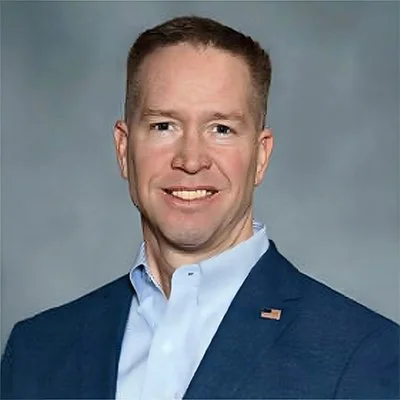
President & Chief Operating Officer
Company Shareholder
Andrew Lawler joined Barry Isett & Associates, Inc. (Isett) in 2024 as Chief Operating Officer after a decade of active military service and 18 years of experience in the management of multi-discipline organizations. He has served in various leadership roles, focusing on client relations, cultivating culture, and enabling growth. Mr. Lawler was promoted to President by the Board of Directors in 2025.
Mr. Lawler provides executive-level management and oversight of Isett’s Design, Field, and Public Divisions and works alongside Chief Executive Officer, Kevin Campbell, PE, LEED AP, to assist in overall company operations, strategic planning, and client relations.
Upon graduation form the United States Navel Academy, Mr. Lawler was commissioned as a second lieutenant in the United States Marine Corps and served over eight years active duty as a KC-130 pilot including multiple combat deployments in support of Operation Iraqi Freedom in 2005 and 2006.
Upon conclusion of his military service, Mr. Lawler joined Lutron Electronics in Coopersburg, PA, holding numerous leadership roles across a variety of business units including service, operations, and sales. Later, he transitioned to VEC Inc, a multi-discipline construction firm headquartered in Youngstown, OH serving the civil, mechanical, and electrical construction markets. Here, he started a separate business unit in Northeast PA focused on electrical construction for the Oil & Gas Industry.
In his prior role as president of West Side Hammer in Bethlehem, PA, Mr. Lawler successfully guided decades-old client relationships while also expanding their market presence, implementing processes and standards to enable growth, and cultivating a culture that encouraged decision making at all levels of the organization. His leadership resulted in historic growth for the company in nearly all aspects of the business.
An active member of the community, Mr. Lawler serves on numerous boards and volunteers with many organizations across the Lehigh Valley. At the Greater Lehigh Valley Chamber of Commerce, He is a member of the Executive Committee, Board of Governors, and the Veterans and Military Council where he recently completed a two-year term as chairman. In addition to his work with the Chamber, Mr. Lawler volunteers and coaches for a variety of organizations including St. Thomas More parish in Allentown, Lower Macungie Youth Association, and the Travis Manion Foundation.
Education
B.S. (with merit), Systems Engineering, United States Naval Academy
Certificate, Leadership & Business Management, Muhlenberg College
Naval Aviation Flight Training, Pensacola, FL and Corpus Christi, TX